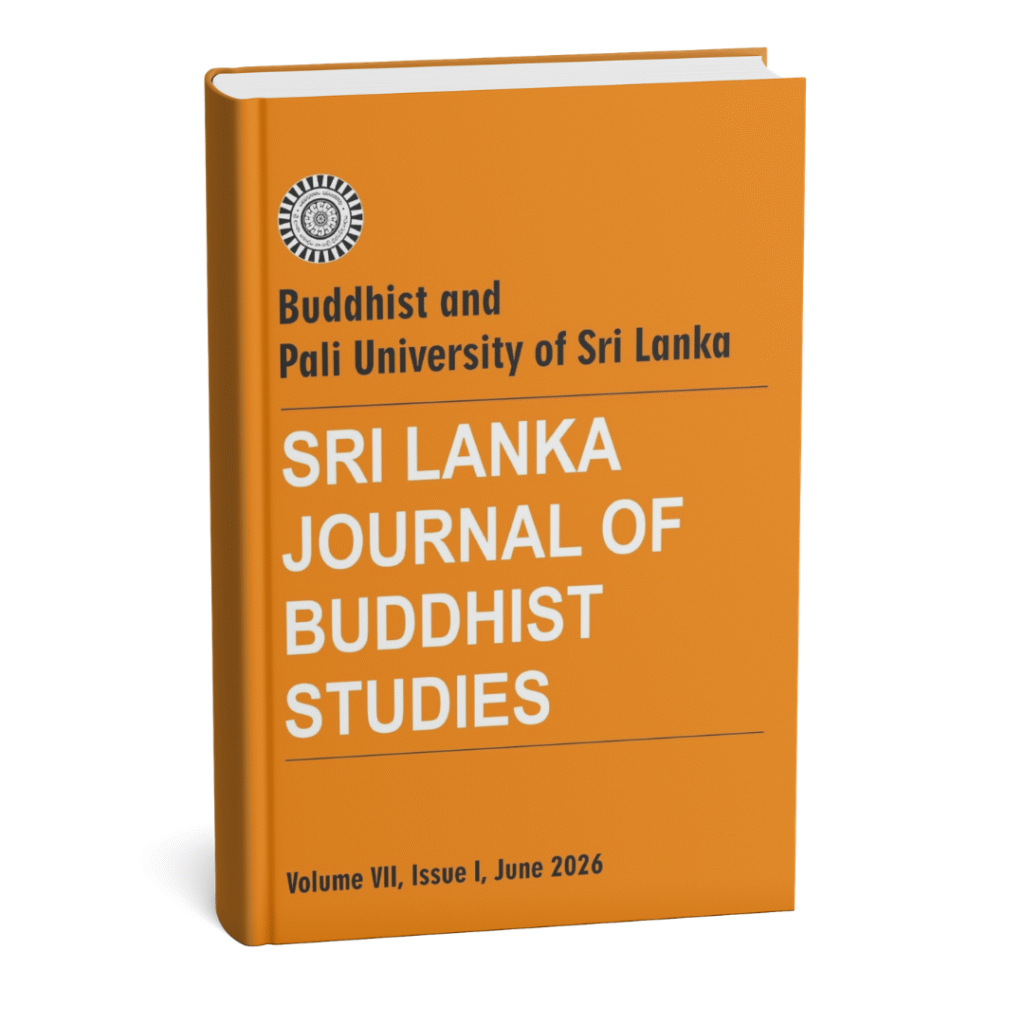
Sri Lanka Journal of Buddhist Studies (SLJBS) is a prestigious, double-blind peer-reviewed academic journal published by the Buddhist and Pali University of Sri Lanka since 1987. Renowned for its scholarly integrity and intellectual depth, SLJBS has consistently featured contributions from leading Buddhist scholars both in Sri Lanka and internationally.
After a brief period of publication hiatus, we are pleased to announce the relaunch of the journal in 2025 as an online, double-blind peer-reviewed publication, reaffirming our commitment to fostering rigorous academic research in the field of Buddhist Studies.
The journal is published biannually in June and December—and welcomes original research articles, book reviews, and scholarly essays that contribute to the advancement of knowledge in Buddhist thought and practice.
SLJBS accepts submissions in a wide range of areas related to Buddhist Studies, including but not limited to:
Editor in Chief
Dr. Nipunika Dilani
Editors
Dr. E.G.I.P. Wickramasinghe
Dr. Nimali Priyangika
Ven. Rideegama Wanrathana Thero
Ven. Pepiliyawala Narada Thero
Research Council at the Buddhist and Pali University of Sri Lanka funds for the publication of SJBS.
Welcome to the submission portal of the Sri Lanka Journal of Buddhist Studies (SLJBS). We invite scholars, researchers, and practitioners to contribute original research articles, book reviews, and scholarly essays related to Buddhist Studies.
All submissions first undergo an initial desk screening by the editorial team to ensure they fall within the journal’s scope and comply with submission guidelines. At this stage, manuscripts may be rejected or returned to authors for preliminary revisions.
Submissions that pass the initial screening are then subjected to similarity and AI usage checks. Manuscripts with more than 10% plagiarism or those that rely on AI for content generation will be rejected.
Following this, manuscripts are assigned to expert reviewers in the relevant field, as recommended by the editorial board and approved by the Vice Chancellor. Each manuscript is reviewed by two experts.
In cases where a reviewer recommends rejection, the manuscript may be sent to a third reviewer if necessary. The final decision is made by the editorial board, based on the reviewers’ evaluations and comments.
The peer-review process takes a maximum of four months:
Submission
Initial Screening by Editors – 1 week
Similarity and AI Screening -2 days
Desk rejection or proceeding to review -1 week
Review by Two Experts – 2 months
Returning to Authors for Revisions – 1 week
Sending Revised Manuscript to Reviewers – 1 week
Final Approval & Publication Process – 1 week
The Sri Lanka Journal of Buddhist Studies (SLJBS) permits a maximum of 10% similarity for both AI-generated content and plagiarism, as assessed through Turnitin. AI tools may be used only to improve the clarity, grammar, and readability of the language. They must not be used to generate the intellectual content, arguments, analysis, or findings of the manuscript.
If a submission exceeds the 10% threshold in the Turnitin screening, it will be rejected by the editors without proceeding to the peer-review process.
Email: sljbs@bpu.ac.lk
Office: Buddhist and Pali University of Sri Lanka, Pitipana, Homagama, Sri Lanka
Tel. +94718677429, + 94775204892, +94712433662