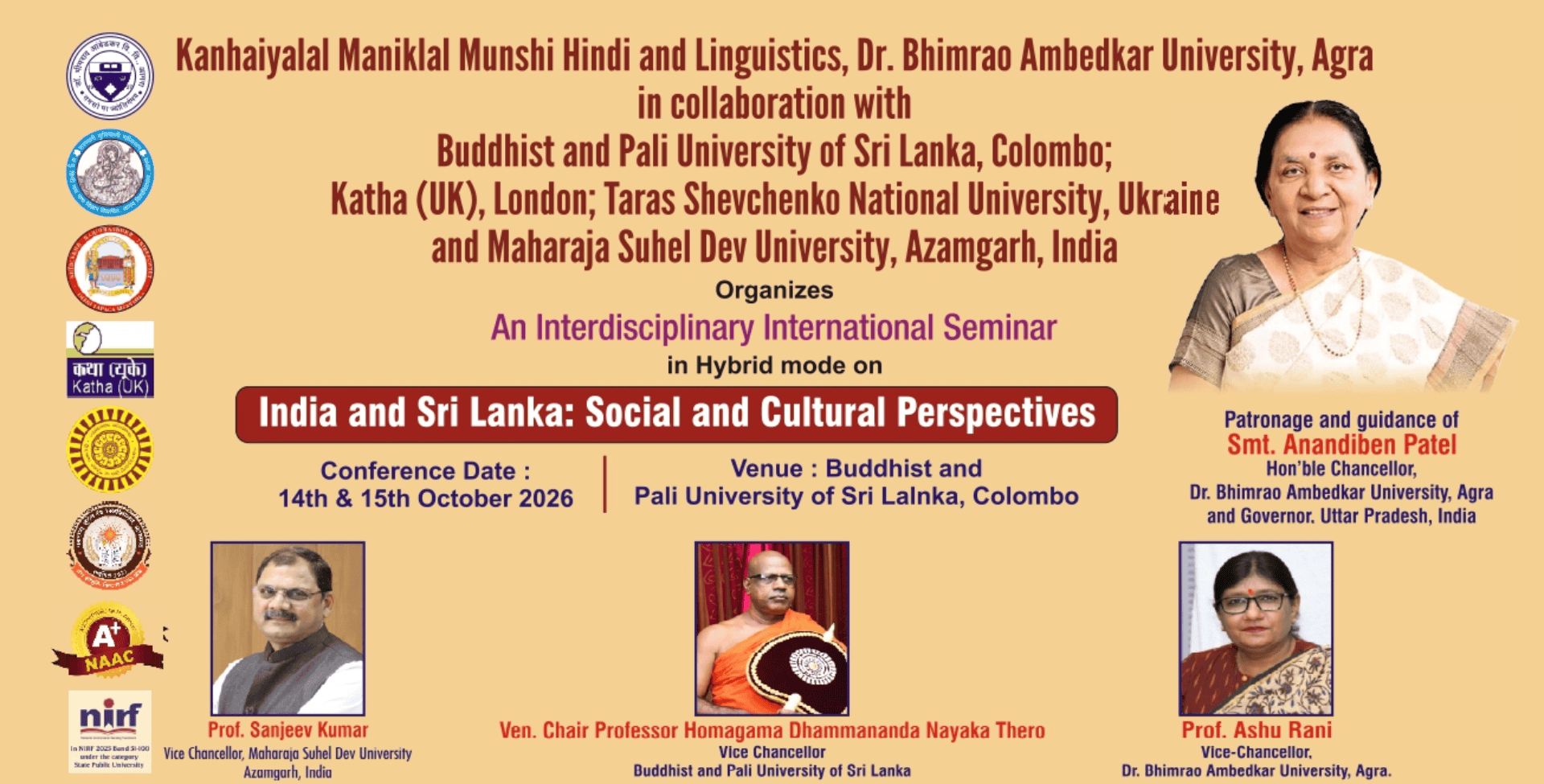
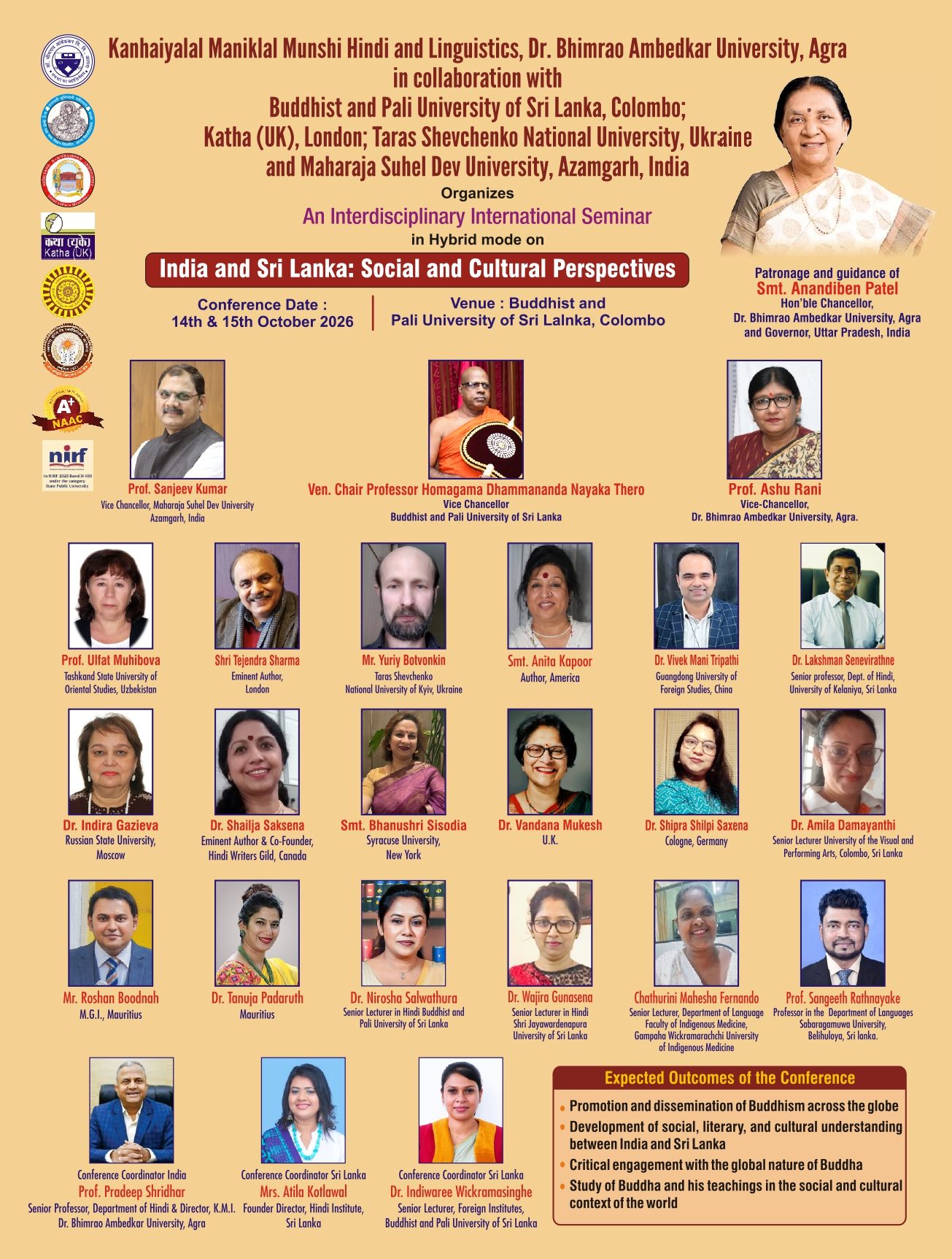
An Interdisciplinary International Seminar
in Hybrid mode on
India and Sri Lanka: Social and Cultural Perspectives
Conference Date
14th & 15th October 2026
Venue
Buddhist and
Pali University of Sri Lalnka, Colombo
Sri Lanka is India’s closest maritime neighbor, situated just 30 nautical miles away. This island nation shares deep historical, social, and cultural ties with India. It is well known that the ‘Ramkatha’ (the story of Rama) holds a unique place in Indian culture. The relationship between the two countries spans more than 2500 years, characterized by a legacy of intellectual, ethnic, cultural, religious, and linguistic exchange. Buddhism has had a profound presence in Sri Lanka since ancient times, and it is believed to be the birthplace of the Theravada sect of Buddhism. Today, Sri Lanka is considered a major center for Buddhist education and thought. It is said that the Buddha himself visited Sri Lanka in the 6th century B.C., and it is believed that he visited three places during his journey. The bed he slept on while staying in the Colombo region is now inside the stupa of the Kelaniya Temple near Colombo. The worship of the Buddha has been symbolically expressed through stupas and Bodhi trees. One of the world’s first stupas was built in present-day Anuradhapura, and nearby, a Bodhi tree was planted from a branch of the original tree under which the Buddha attained enlightenment in India.
The credit for the arrival of Buddhism in Sri Lanka goes to Ashoka’s son Mahindra and daughter Sanghamitra, who arrived on the island in the middle of the 3rd century B.C. When Mahindra propagated Buddhism in Sri Lanka, he met King Devanampiya Tissa at a place called Mihintale (near the capital, Anuradhapura). Influenced by his teachings and signs, the King and his subjects accepted this faith. Subsequently, King Tissa built pilgrimage sites and monasteries in his capital. Following Mahindra’s instructions, he organized the Thuparama Council so that the holy scriptures could be memorized and taught by local monks. Gradually, these ties between India and Sri Lanka deepened over time. Since the 1830s, the British began bringing indentured laborers from India, particularly from Tamil Nadu, to Ceylon. The Tamils sent by the British settled in the northern part of Ceylon. Sri Lanka gained independence from the British on February 4, 1948. From 1815 to 1948, Sri Lanka was under British rule. On May 22, 1972, Sri Lanka became a republic and was renamed the Republic of Sri Lanka. The Cultural Cooperation Agreement signed between the governments of India and Sri Lanka in New Delhi on November 29, 1977, forms the foundation for periodic cultural exchange programs between the two countries.
It is noteworthy that in recent years, bilateral relations and cooperation have increased in the areas of development, trade, investment, education, culture, and defense. Strong political relations between India and Sri Lanka include growth in trade and investment, as well as comprehensive cooperation on major global issues of development, education, culture, defense, and international interest. In recent years, India has made significant contributions to the progress of implementing developmental assistance projects for internally displaced persons and underprivileged sections of the population in Sri Lanka. This has helped in bringing greater depth to the relations between the two countries. Sri Lanka participates in regional organizations such as BIMSTEC (Bay of Bengal Initiative for Multi-Sectoral Technical and Economic Cooperation) and SAARC (South Asian Association for Regional Cooperation), where India holds a prominent position. Sri Lanka has also consistently demonstrated a sense of respect for India. Sri Lanka is India’s closest maritime neighbor and is strategically located in the Indian Ocean and the Bay of Bengal. Sri Lanka plays a significant role in ensuring regional security, particularly through cooperation in maritime security and counter-terrorism efforts. Cultural and historical ties with India, especially regarding Buddhism, enhance bilateral relations. In accordance with its ‘Neighborhood-First Policy’ and the ‘SAGAR (Security and Growth for All in the Region) doctrine,’ India attaches great importance to Sri Lanka to keep the Indian Ocean region peaceful and secure. The Indian Cultural Centre in Colombo actively promotes awareness of Indian culture by providing classes in Indian music, dance, and Hindi. This center also organizes the International Day of Yoga program every year. The India-Sri Lanka Foundation was established to enhance scientific, technical, educational, and cultural cooperation through civil society exchanges. Shared democratic values and a multi-party system are the strong foundation of democratic dialogue between the two countries. India is a reliable partner in Sri Lanka’s progress and economic stability. Cooperation is rapidly increasing in new areas such as energy, innovation, connectivity, and fintech, thereby strengthening bilateral relations. To nurture the ancient cultural, social, and spiritual relations between India and Sri Lanka, an interdisciplinary international seminar on the theme “India and Sri Lanka: Social and Cultural Perspectives” is being organized at the Buddhist and Pali University of Sri Lanka, Colombo, in which renowned scholars and litterateurs from within the country and abroad will participate.
Calling for Abstracts and Research Papers
Deadline for submitting research papers is July 20, 2026
Expected Outcomes of the Conference
- Promotion and dissemination of Buddhism across the globe
- Development of social, literary, and cultural understanding between India and Sri Lanka
- Critical engagement with the global nature of Buddha
- Study of Buddha and his teachings in the social and cultural context of the world
Proposed Sub-Topics
- The emergence and development of Buddhism
- The life and historical significance of the Buddha
- Buddhist ethics
- Buddhist philosophy and the five precepts of Buddhism.
- The spread of Buddhism from India to Sri Lanka and Asia.
- Buddhism and social values: compassion, non-violence, and cooperation
- Buddhism in the Ramayana era
- The Bhakti period and Tamil Literature
- India and Sri Lanka: cultural exchange
- India and Sri Lanka: international diplomatic relations
- Buddhist place-based and structural schemes in Sri Lanka
- Ram in the local folk-narratives of Sri Lanka
- The Bravery and Bhakti of Lord Ram and Lord Hanuman
- The compassionate roles of Sita and Shabri
- Kavi Kamban’s Ram: the Supernatural and the Ideal Man
- The depiction of War, Nature and Emotions in Kamb Ramayana
- A Comparative Study of KambRamayan and Valmiki Ramayan
- Traditions and Rituals of Buddhism: Theravada, Mahayana and Vajrayana
- Stories from Buddha’s life and tales of Buddha from Pali, Sanskrit, Sinhal and Indian traditions
- Buddha in the contemporary culture of India and Sri Lanka
- Karma, Reincarnation and Nirvana in Buddhist philosophy
- The spread of Buddhism in Sri Lanka: Theravad, Mahayana and Vajrayana Buddha in the folktales of Sri Lanka
- India, Sri Lanka and the historical significance of Buddha
- Dravidian languages and Tamil
- Sinhala language and its linguistic research.
- The relationship between the Tamil of India and Sri Lanka
- The historical importance of India, Sri Lanka, and Tamil language
Proposed Sub-Topics
- Linguistic research of the Tamil of India and Sri Lanka
- Sinhala and Tamil: The cultural links between languages
- Cultural study of Bharatanatyam, Kathak and Kandiyan Dance forms
- Trade relations between India and Sri Lanka
- India and Sri Lanka: Cultural and sociological studies
- India-Sri Lanka Agreement (1987)
- India-Sri Lanka relations in the context of military, energy, and trade investments
- India and Sri Lanka: various security arrangements
- India and Sri Lanka: Joint Infrastructure Projects The socio-historical and ethno-cultural importance of Ram Setu, Rameswaram, Agni Teertha, and Dhanushkodi
- The study of the Sangam literary tradition
- A study of the great Tamil epics: Silappadikaram, Manimekalai, SivakaCintamani, Valayapathi and Kundalakesi
- The influence of Dravidian culture on Sri Lanka
- The study of the Kamb Ramayana
- Hindu Shaiva beliefs in the Tamil society of Sri Lanka
- India and Sri Lanka: economic and commercial issues. Impact of Liberalization on the economy of Sri Lanka
- India and Sri Lanka: status of Bi-Lateral Trade India and Sri Lanka: geo-strategic and geo-political importance.
- The conservation and spread of Buddhist monasteries and ancient shrines under the Sri Lankan government India-Sri Lanka relations in the context of Tourism India-Sri Lanka comprehensive security cooperation in the Indian Ocean Maritime Security cooperation and the role of ports in India-Sri Lanka relations
- Cultural diplomacy and people-to-people exchange: the role of cultural centers, museums, and festivals
- Sanskrit, Pali and Classical Languages as a bridge for civilization contact between Indian and Sri Lanka
- India’s development cooperation, lines of credit and crisis assistance to Sri Lanka Heritage, Pilgrimage and the Ramayana tourism circuit as drivers of local development
Paper Submission Guidelines
- Participants are invited to submit abstracts and full research papers.
- Selected papers will be published in an edited volume with ISBN.
- Papers must be submitted in Unicode (Mangal/Arial font) in Word format. Maximum word limit: 3000 words
- For queries regarding contact Dr. Nitin Sethi (Mobile: 9027422306)
- Submit papers to: kmiseminar2026@gmail.com
- Participants who are interested in presenting summaries of their research papers (Online and Offline) have to contact Miss Shivani Chouhan (7838195100). Presentation time: 5 minutes (online/offline)
- Please include full name, affiliation, address (with pincode), contact details, and email. The organizers will
- not be responsible for any difficulty in publication because of the lack of these details.
- The deadline for submitting research papers is August 10, 2026. Papers received till the last date will be presented in edited book format at the inaugural session of the seminar.
Registration Fees :
- Teachers: Rs. 2500
- Research Scholars: Rs. 2000
- Students: Rs. 1500,
- International Participants: $100
Chief Convenor and Contact
Prof. Pradeep Shridhar
Senior Professor
Department of Hindi and Director, K.M.I.
Dr. Bhimrao Ambedkar
University, Paliwal Park, Agra – 282004
Contact: 98373 50986